
Your Salesperson Left. Who Owns the Deals Sitting in Their WhatsApp?
Your Salesperson Left. Who Owns the Deals Sitting in Their WhatsApp?
Your salesperson leaves on Friday.
On Monday morning, a customer messages them:
“We’re ready to proceed. Can you send the revised quotation?”
But your salesperson is no longer with the company.
- Who sees that message?
- Who knows what price was discussed?
- Who remembers the customer’s objection?
- Who knows what was promised—and what was never approved?
Your CRM says:
“Quotation sent.”
But the real conversation is sitting in someone’s private WhatsApp.
- The revised price.
- The customer’s concern.
- The negotiation history.
- The next meeting.
Your replacement salesperson has to ask the customer to explain everything again.
And the customer thinks:
“I already explained this to your company. Why am I starting from zero?”
This is not just an employee handover problem.
It is a customer relationship risk. And it can become a revenue problem.
Your CRM May Know the Deal Stage. Does It Know the Customer Story?
Many businesses believe their sales process is digitised because they use a CRM.
But a CRM can contain:
- The lead name
- The quotation amount
- The deal stage
- The date of the last activity
…and still miss the information that actually moves the deal forward.
- The customer’s latest request.
- The reason they delayed.
- The revised commercial terms.
- The commitment made during a call.
- The next action someone must take.
When these details remain scattered across private WhatsApp chats, phone calls, email threads, and individual memory, the company has a record of the deal—but not necessarily control of the deal.
The salesperson knows the customer. The company should own the relationship.
The Real Test of Your CRM
Ask yourself:
If your salesperson were unavailable tomorrow, could another colleague continue their top five deals without asking the customer to repeat the conversation?
Before your next handover, check:
- Can another colleague find the latest quotation and its revision history?
- Are customer requests clearly separated from approved commercial promises?
- Does every active deal have one accountable owner and a defined next action?
- Can a colleague see the latest customer interaction—not just the last CRM update?
- Can conversations continue after the original salesperson’s access is removed?
- Can management identify deals that are stalled, overdue, or at risk?
If several answers are “No,” the problem may not be your salesperson.
Your sales process may be depending on individual memory instead of company-owned information.
What a Proper Sales Handover Should Look Like
A reliable handover should not depend on a farewell email or a spreadsheet prepared on the employee’s last day.
For every active opportunity, the company should be able to find:
1. Customer Context
Who is the customer? What do they need? Who are the decision-makers?
2. Commercial Context
Which quotation was sent? What changed? What terms were discussed? What is approved?
3. Conversation History
What did the customer ask? What was the response? What is still unresolved?
4. Next Action
Who must do what, and by when?
5. Ownership
Who is accountable now—and who is the backup?
The objective is simple:
The employee may leave. The customer relationship must not leave with them.
How INBO CRM Helps Address This Problem
At INBO, we believe a CRM should do more than store leads and show deal stages.
It should help businesses maintain continuity across people, conversations, and customer requirements.
INBO CRM is designed to make the business journey traceable:
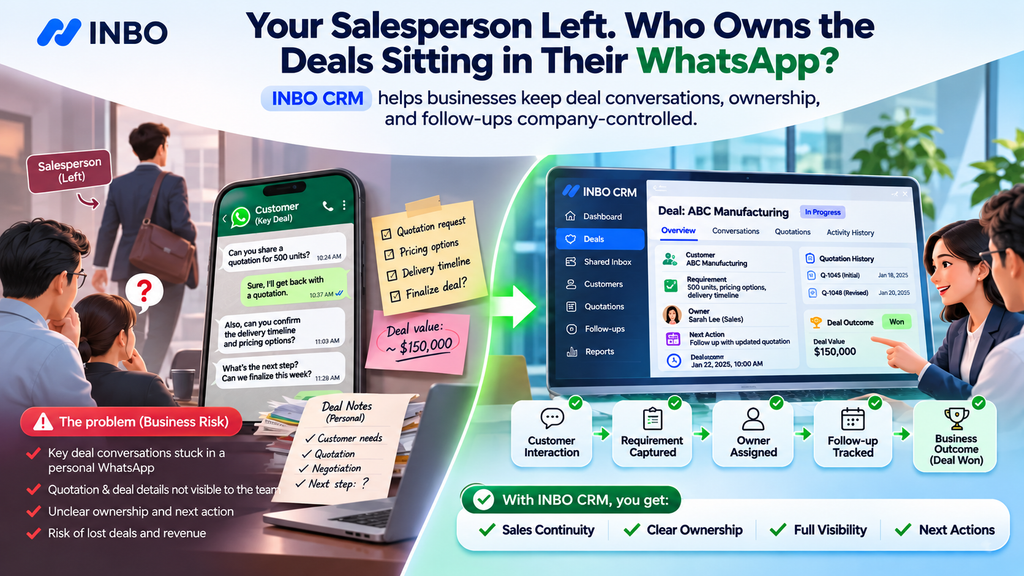
Customer interaction → Requirement captured → Owner assigned → Follow-up tracked → Business outcome recorded
This helps businesses work toward:
- A shared view of customer and opportunity history
- Clear ownership of active deals
- Defined next actions and follow-up tasks
- Visibility into overdue or stalled opportunities
- A traceable record of how a requirement was converted—or closed with a reason
For businesses that want to move customer conversations away from employees’ private numbers, a company-owned WhatsApp Business Platform number connected to a shared CRM inbox can be part of the solution.
The company owns its WhatsApp Business account and number. Employees use their individual CRM logins to manage assigned conversations. The business retains the authorised conversation history and can reassign work when an employee changes roles or leaves.
But connecting a tool alone does not automatically recover old chats, reconstruct missing context, or create a complete handover.
The process has to be designed. The information has to be captured. The ownership has to be clear.
That is where a CRM becomes more than a database.
It becomes part of how the business operates.
A 10-Minute Sales Continuity Check
Choose your five most important active deals.
Ask a colleague who is not the current salesperson to find:
- The latest customer request
- The latest quotation
- The main objection or unresolved issue
- The next committed action
- The person responsible for that action
Then ask them to continue the conversation.
Can they do it without asking the customer to start over?
If not, you have discovered a process gap before it becomes a customer problem.
The Question Every Sales Leader Should Ask
A CRM should not just tell you what stage a deal is in.
It should help your company understand what the customer needs next—and who is responsible for making it happen.
At INBO, we are building toward that standard.
If your salesperson were unavailable tomorrow, could someone else continue their top five deals?
If this is a challenge in your business, message me “CONTINUITY”. I’d be glad to discuss how a company-owned conversation and CRM workflow can help your team reduce handover gaps.
#INBO #CRM #SalesManagement #B2BSales #RevenueOperations #CustomerExperience